How to Extend the Life of Your Tankless Water Heater with Regular Repairs
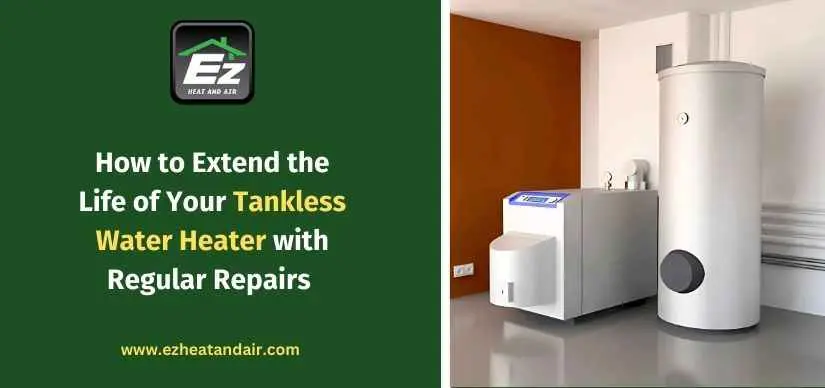
Routine descaling, an annual professional inspection, and addressing small warning signs before they become major failures are what allow a tankless water heater to reach its full service life.
Descale and Flush On a Regular Schedule
Because much of San Diego, Riverside, and Orange County has moderately hard water, mineral scale builds up on the heat exchanger inside a tankless unit faster than manufacturers often assume. That scale insulates the exchanger from the water passing through it, forcing the unit to work harder and shortening its lifespan.
Flushing the system with a descaling solution once a year (or every six months if you don't already have a water softener) keeps the exchanger clean and lets the unit heat water efficiently instead of straining against scale buildup.
Schedule an Annual Professional Inspection
A tankless water heater has more electronic components than a traditional tank, including sensors, a control board, and an ignition system. A yearly inspection lets a technician check the inlet filter, verify proper venting, confirm gas pressure and combustion, and catch small problems while they're still inexpensive to fix.
Don't Ignore Early Warning Signs
Tankless units are designed to alert you before they fail outright. Pay attention to:
- Error codes on the display – Most manufacturers assign specific codes to specific problems; noting the code before calling for repair helps a technician diagnose it faster.
- Inconsistent water temperature – Often an early sign of scale buildup, a failing flow sensor, or a venting issue.
- Longer wait times for hot water – Can point to a flow restriction or an aging heat exchanger.
Addressing these signs with a repair as soon as they appear is almost always cheaper than waiting for a full breakdown.
Keep the Venting and Air Intake Clear
Tankless units rely on proper airflow for safe combustion. Keep the exterior vent termination free of leaves, debris, and nesting insects, and make sure nothing is stacked in front of the intake indoors. Restricted airflow can trigger shutdowns or, in gas units, create a safety hazard.
Conclusion
A tankless water heater can last well over a decade when it's descaled on schedule, inspected annually, and repaired promptly at the first sign of trouble. If you're noticing error codes or inconsistent hot water, our team can diagnose the issue and get your unit back to full efficiency. See our water heater leak troubleshooting guide if you're dealing with a leak instead of a temperature problem.
FAQs
Q1. How often should a tankless water heater be descaled?
Once a year is typical, though homes without a water softener in harder-water areas may benefit from descaling every six months.
Q2. What does an error code on my tankless water heater mean?
Error codes point to a specific fault, such as a flow, ignition, or venting issue. Write down the code and give it to your technician so the repair can be diagnosed quickly.
Q3. Can I descale a tankless water heater myself?
Some homeowners flush their unit with a DIY descaling kit, but a professional inspection at the same time catches problems a flush alone won't reveal.
Category